
By Ny Avo Rasolomanana
The journey to finding sustainable solutions to some of the planet’s greatest challenges has begun! Our research group recently completed a preliminary field trip for the Sustainable Climate Smart Adoption and Land-use change for Food Security (SCALE) Project, marking the exciting first steps of my PhD research.
The core challenge: Food vs Forest
At the heart of the SCALE project lies a question that has long animated scientific debates: How can we feed a growing global population without sacrificing the ecosystems we rely on, especially forests?
Our research tackles this challenge by examining how sustainable farming approaches, particularly Climate-Smart Agriculture (CSA), can be strengthened and scaled. The goal is to understand the socio-ecological conditions that allow CSA to deliver the best outcomes for both food production and environmental conservation, with a strong focus on forest preservation.
A key part of this work involves assessing the trade-offs between land sparing and land sharing. Should agriculture become more intensive to free up land for biodiversity? Should it move toward more environmentally friendly practices that integrate conservation into agricultural landscapes? Or is a hybrid approach the most realistic path forward ?
We are also investigating a crucial but often overlooked question: Does increasing yields actually reduce agricultural expansion—or could it unintentionally encourage it ?
Fieldwork : reality discovering, exchange and capacity building
From September 9th to 16th, 2025, our team carried out a 10-day preliminary field mission, an essential step in understanding the realities on the ground, strengthening our methodological skills, and building the capacities needed for the SCALE project.
. Where we went & who we were?
Our journey began in Itremo, a vast grassland ecosystem in the highlands of Madagascar, before continuing to Ranomafana–Ifanadiana, home to rich wet forests in southeastern Madagascar. Comparing these contrasting landscapes was crucial for shaping our research design.
The field team included two PhD researchers alongside our supervisors : Dr. Sarobidy Rakotonarivo (Mitsilo Lab – LRA – ESSA Forêt) and Dr. James Borrell (Royal Botanic Gardens, Kew).

The research team, ready to explore the core zone of the gallery forest at Itremo Protected Area for data collection practice
. Experimenting and fine-tuning data collecting methods
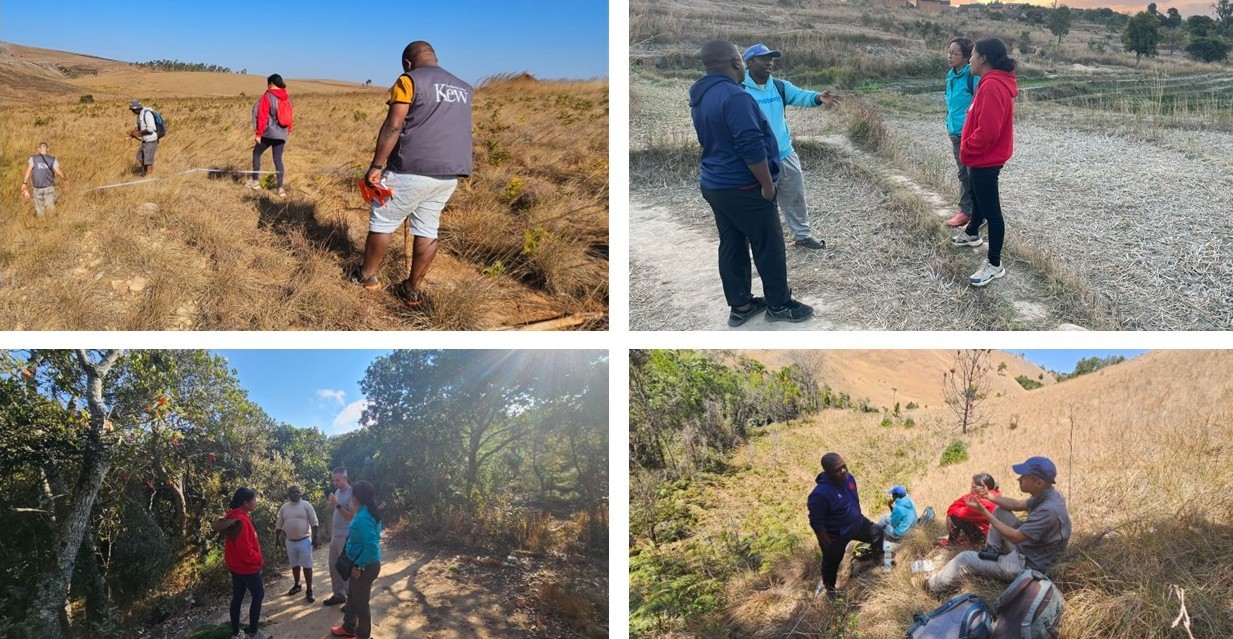
Teamwork in action: reflection, learning, and practical exercises on surveying sites
The core purpose of this fieldtrip was to test, refine, and strengthen the tools and techniques we will use to study the land sharing vs. land sparing continuum. This hands-on work involved:
- Observing varying degrees of agricultural land-use intensity across landscapes
- Practicing site selection (taking interesting points and squares)
- Training in surveying sites through four key dimensions:
-
-
- Biodiversity
- Agrobiodiversity
- Yields
- Social parameters
-
-
- Engaging in early conversations with farmers, both those using sustainable practices (e.g., agroforestry) and those relying on conventional or traditional methods
These farmer exchanges were particularly insightful. They opened discussions on yield estimation, crop varieties, daily constraints, off-farm economic activities, and conservation behaviors, offering a grounded understanding of the socio-ecological dynamics shaping land-use decisions.
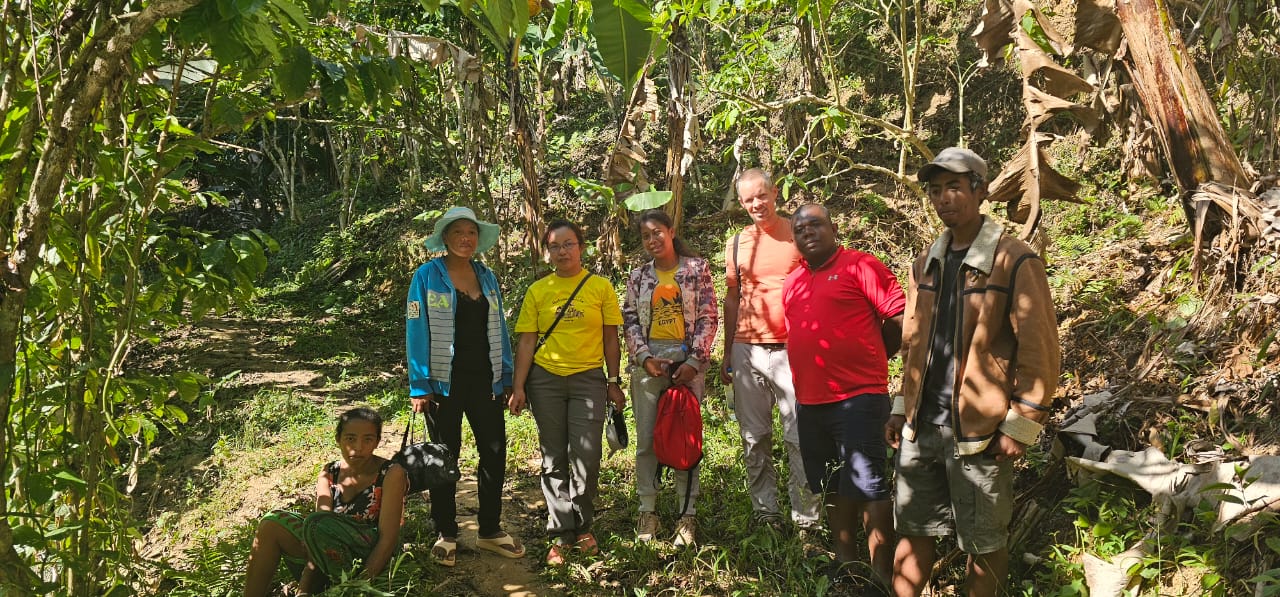
In Ranomafana, meeting these sibling farmers who successfully integrate their lives with Agroforestry
Highlights of the trip
Beyond methodology, this field trip was an enriching scientific and personal experience:
- We were struck by the beauty and diversity of the landscapes—from highland terraces to the forest galleries of the Protected Area.
- Crossing the core zone of the grassland ecosystem was a full day of learning, discovery, and immersion.
- Travelling to Ranomafana revealed striking differences in landscape transitions.
- We completed the six-hour Ornitho Trail in Ranomafana National Park, exploring Madagascar’s exceptional endemic birdlife.
These moments reinforced our motivation and reminded us why this research matters.

Madagascar’s endemic Scaly Ground-Roller (Geobiastes squamiger). This unique bird inhabits the eastern rainforests at low and middle elevations
The value of a preliminary fieldwork
This fieldwork was crucial. It allowed us to understand and observe the local context—the landscape, physical environment, and socio-economic realities—in a way that desk research cannot.
Most importantly, it helped us:
- Find and refine our research questions
- Enrich our hypotheses
- Test and refine data collecting methodology
- Anticipate logistical challenges ahead
A promising beginning
The SCALE project is off to a strong start. As we move forward, we aim to deepen our exploration of how sustainable agriculture can support food security, livelihoods, and forest conservation in Madagascar.
Stay tuned for more updates as we continue this exciting research journey!