
By Eddy Josephson Randriamihary,
It was July 2025, and after doing a three-month research visit at the Potsdam research institute in climate impact research (PIK) in Germany, I travelled to America, a place where everything is big but where the gates can feel tight: immigration rules, costs, and the invisible social barriers that shape who gets to be where. I spent one entire month in the US attending the ICPSR Summer Program at the University of Michigan. I always knew that I would one day have the opportunity to visit Europe, but following advanced methods courses in the USA? As a younger student, that was something I would only imagine in my deepest sleep, when no one was looking.
In my PhD, I’m trying to answer a set of very practical questions. What happens when a savings group receives a cash injection? Do members change how they manage money, how much they save, whether they borrow, and what they choose to spend or invest in? Do these changes last over time, or do they disappear after a few months? Why do some people benefit more than others? And most importantly, do these changes actually lead to better outcomes, like more investment in more sustainable farming techniques like climate-smart agriculture, higher off-farm incomes, and improved wellbeing? These questions matter for decision-makers in countries like Madagascar, where many households struggle to access money when they need it. When people don’t have enough cash or affordable ways to borrow, it can make it harder to cope with climate shocks, escape poverty, and avoid overusing natural resources just to get by.
I’m using an innovative study design, and more importantly, some of my questions can’t be answered by a simple “before-and-after” comparison or by a single headline number. We do look at average effects, of course, but we also care about what happens over time: how people’s behaviour and outcomes change in the weeks and months after a cash injection, whether those changes build up, level off, or fade out. We also examine who benefits most (and least) by looking at how impacts differ across groups, for example by age, gender, and household circumstances such as land holdings. Answering that means using tools that can track these patterns over time, not just one snapshot. In that sense, the ICPSR Summer Program was a perfect fit for what I need for my PhD.
I took two live courses and followed two others asynchronously. The courses were very demanding in terms of time and effort, even though they were delivered in a very accessible way. Reading materials were provided during the first week of the summer program and at the beginning of the core courses, which made the transition smoother.
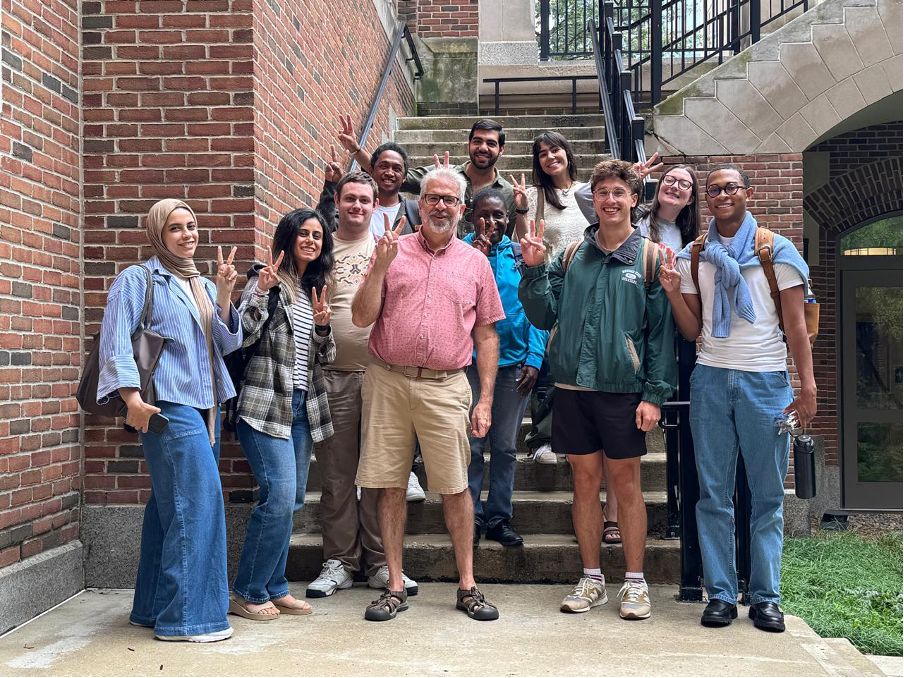
Regression analysis II was the foundation. Never begin your adventure into the realm of econometric models without that solid ground. Professor Tim McDaniel took us progressively from the very beginning to more advanced regression analysis. And no worries! That excellent and hilarious professor from Buena Vista University (and yes, he insisted on the pronunciation), always made sure you ‘Got it’ before moving to the next topic. His teaching style is astonishing. I particularly appreciated the way he combines mathematics with stories about pork queens and tractor shows from his hometown, Storm Lake City, Iowa. By the way, here’s a photo of our class with him in Regression Analysis II.
I have developed a personal habit when travelling abroad (yes, I know). I love testing local food. And let me say this in the most scientific way possible: as far as I know, I have never eaten a doughnut that beats the American one. The coffee and doughnuts every Wednesday morning before class in Michigan were simply excellent. From the moment the summer program schedule was out, I declared that my favourite day in the US was Wednesday, or more precisely, donut Wednesday as I called it myself. Do donuts boost your nerd skills? The answer is definitely yes, with 99% confidence, no need to run an experiment or estimate an empirical simplification of the process generating the outcome.
I really hesitated before taking Rob’s course. I felt that Empirical Modelling of Theory was one of the most advanced courses of the 2025 Summer Program. (Yes, Rob, I would name the course that way). However, as soon as I heard Rob’s introduction, or rather, “an introduction”, I knew I had a place in that classroom. More than that, I knew it was going to be the most exciting nerd course I had ever taken. I truly appreciated the way he led the course. He warned us from the beginning that he would follow an argumentative teaching style, and he did. As he used to say, “everything is progress….” I think I found the way I want to orient my research career.
I came to Ann Arbor with a very clear purpose. One month is not long enough to fully settle in, and that sense of urgency shaped everything. From the start, I knew that this place had something I needed for my PhD. ICPSR is intense and highly structured. The classes are packed, and the format doesn’t really leave room for sitting back and just ‘taking it in’. You have to stay engaged and keep making connections. I found myself constantly asking: How does this fit into my research? What does this training equip me to do differently? And, more broadly, what kind of social scientist is it pushing me to become?
“An econometrician wants the best estimate of the empirical manifestation of their theoretical model, and a statistician wants the best estimate ….” Rob Franzese
And a small piece of advice, from nerd to nerd: don’t try to write your PhD paper while attending the Summer Program. The training will make you want to rerun everything, tweak specifications, and double-check every assumption. You might never finish the paper on time, though your models will be significantly more robust. Ann Arbor surrounded me with people, social scientists from all over the world, yet it also kept me very much in my own head. I spent most nights working on that article. My return flight to Madagascar was at 2 a.m., and I spent my last night at the airport finalising a draft to submit to a conference. At the time, I didn’t know that the conference would simply reject it.
On the last day before leaving Ann Arbor, a group of classmates and I gathered in the kitchen of Stockwell Hall for one last moment together before saying goodbye. I was thinking about every choice I had made that brought me to that exact moment, the right place, the right time, standing on solid ground. Germany covered me with the best sweat. Michigan rolled my sleeves up. I finally knew what I was doing in this PhD. And more importantly, Michigan taught me that the next step for me is no longer about learning more tools, but about deciding what I want my work to stand for.
My participation in the ICPSR Summer Program was made possible by the Scholarship for Public Administration, Public Policy, and Public Affairs. To the best of my knowledge, I am the first African to receive this support. I am also deeply grateful for the ARISE grant, managed by the African Academy of Sciences, whose commitment continues to strengthen research capacity across the continent.